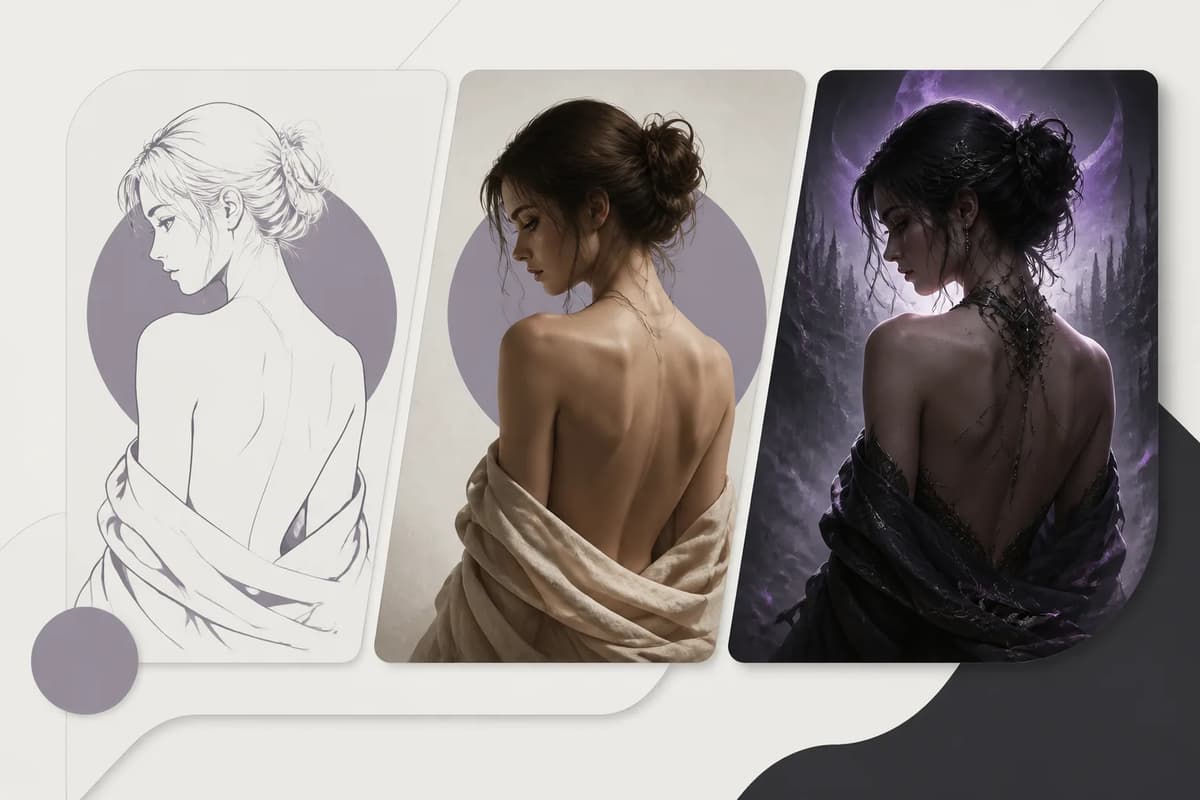
Choose anime when you want graphic silhouettes, controlled line work, and stylized expression; semi-realistic when recognizable anatomy, material texture, and photographic light matter; dark fantasy when costume, atmosphere, dramatic contrast, and a designed world carry the image. The best style is the one that supports your character and next workflow, not the one with the most detail.
Compare the visual contracts
Each style changes how identity is expressed. Anime compresses facial detail into shapes and color relationships. Semi-realistic rendering uses more skin, hair, and material texture, so small anatomical errors become obvious. Dark fantasy often adds complex costume and lighting that can strengthen mood but compete with the face.
| Style | Strongest controls | Common risk | Best reference |
|---|---|---|---|
| Anime | Silhouette, line, palette, expression | Generic face or inconsistent proportions | Clean illustrated portrait |
| Semi-realistic | Face geometry, texture, natural light | Uncanny skin or anatomy | High-quality authorized portrait |
| Dark fantasy | Costume, environment, contrast, atmosphere | Identity hidden by detail or shadow | Clear portrait plus separate mood reference |
Keep the subject clearly adult in all three. Stylization does not excuse age ambiguity. Use adult presentation, mature facial structure, and unambiguous context. Do not use “young-looking” as a shortcut for a visual style.
Prompt anime through shapes and line
Describe full-color anime or manga illustration, clean coherent line work, controlled cel or soft shading, readable hair silhouette, and a finished background. Name camera distance and composition. For character identity, preserve hair shape, eye color, face outline, and signature accessories rather than demanding photographic similarity.
Anime is effective for one-scene comics because gesture and expression can communicate relationship tension quickly. It can also handle stylized fantasy characters without requiring skin-level realism. Exclude panels, speech bubbles, captions, and watermark when the desired output is one complete image. The adult comic prompt guide provides a full worksheet.
Prompt semi-realism through materials and light
Describe natural facial proportions, believable skin and hair texture, accurate fabric behavior, and a specific light source. Avoid stacking “photorealistic,” “cinematic,” “ultra detailed,” and other broad terms without explaining the image. State whether the light is window daylight, warm interior light, or controlled studio light.
Semi-realism can preserve an authorized reference more recognizably, but it exposes identity drift and anatomy errors. Use a clear source image and keep background complexity moderate for the first result. Review hands, eyes, teeth, skin transitions, and clothing edges at full size.
Prompt dark fantasy through hierarchy
Dark fantasy needs a hierarchy: adult character first, costume second, environment third, effects last. Name one costume concept, one architectural or natural setting, and one dramatic light source. Too many horns, chains, weapons, glowing symbols, and creatures will obscure the person and create artifacts.
Use controlled contrast so the face remains readable. Describe the palette—deep crimson and black, cold moonlight and silver, or warm candlelight and aged gold—rather than requesting “epic darkness.” If the character must remain consistent, keep a neutral portrait alongside the fantasy result. Our Adult Character Creator includes dark fantasy as one fixed visual style.
Test the same character across styles
Use one adult identity, presentation, archetype, camera distance, and neutral setting. Generate an anime, semi-realistic, and dark-fantasy version while changing only the style. Review whether face shape, hair silhouette, build, and adult age cues remain compatible. Do not demand identical pixels; decide whether a viewer would recognize the same designed person.
Score:
- Identity readability.
- Adult status clarity.
- Style coherence across face, clothing, and background.
- Anatomy and hands.
- Material and light quality.
- Usefulness as a reference for the next workflow.
The NSFW character consistency guide offers a more detailed scorecard.
Match style to the next output
For a comic series, anime or manga style can make line and palette continuity easier to judge. For makeovers that depend on fabric, lighting, and recognizable identity, semi-realistic style can be useful. For roleplay characters and dramatic single illustrations, dark fantasy creates a stronger world, but the neutral character reference should stay separate.
For image animation, use a starting image with clear limbs and a manageable background regardless of style. Highly detailed fantasy effects can produce unstable motion. Anime motion benefits from a clean silhouette. Semi-realistic motion needs believable anatomy. Dark-fantasy motion should focus on one action or camera move.
Use optional prompts sparingly
Start from the selected style and archetype, then add one supporting detail. Anime: “white silk shirt, neon window light.” Semi-realistic: “emerald velvet dress, warm library light.” Dark fantasy: “silver ceremonial armor, moonlit ruined hall.” These details specify material and environment without replacing the style control.
Avoid repeating the interface labels or mixing rendering contracts. “Anime semi-realistic photoreal dark fantasy” gives no clear priority. If you want a hybrid, identify the base—such as “semi-realistic anatomy with restrained dark-fantasy costume”—and test it separately after the three core styles.
Final choice
Choose anime for graphic clarity and expressive single-scene art, semi-realistic for recognizable texture and natural lighting, and dark fantasy for designed atmosphere and costume. Establish a clearly adult identity first, test one style at a time, and preserve a neutral anchor. Flowith’s Adult Character Creator lets you compare all three with fixed presentation and archetype controls, while the Adult Comic Generator carries the selected identity into a complete scene.
For a multi-asset project, write a one-line style rule before generating: what the line or texture should do, how light behaves, and which palette dominates. Apply it to portraits, comic scenes, and covers. This compact rule prevents a project from drifting into a generic mixture when different collaborators add optional prompts.