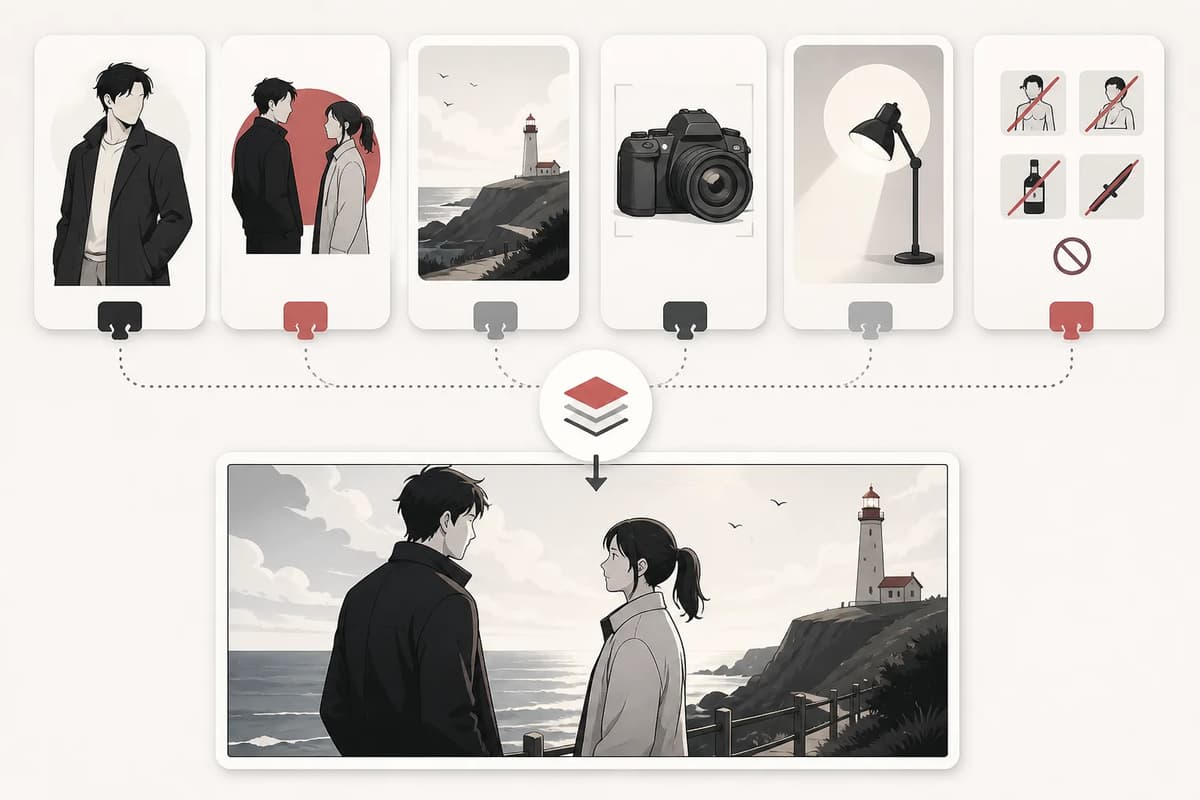
A strong adult comic prompt describes one complete image: who the clearly adult characters are, what relationship or tension is visible, where the scene takes place, how the camera frames it, what the light should communicate, and what must not appear. Do not ask a single-image workflow for panels, dialogue, captions, or a full story. Use a preset for the core scene and an optional prompt only for supporting details.
Start with the primary character
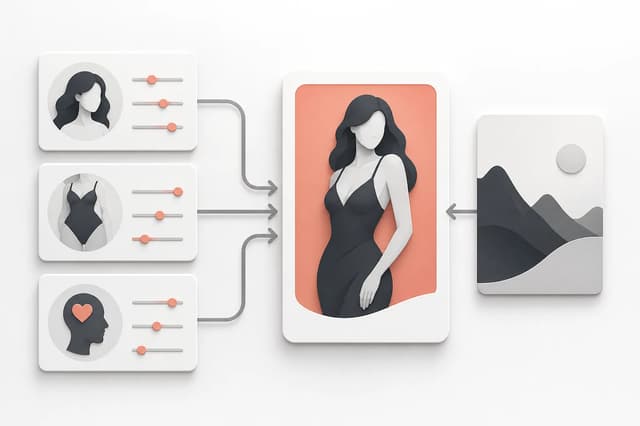
Use a clean authorized reference and identify which person must remain recognizable. Preserve face, hair, adult age cues, body build, and signature details. Do not overload the prompt with temporary expression or wardrobe if those are already specified by the scene. State that all depicted people are consenting adults and avoid age-ambiguous language.
If no stable character exists yet, create one first with the Adult Character Creator. Save a neutral portrait as the comic reference. The NSFW character consistency guide explains why a clear portrait works better than a cropped adult scene.
| Prompt layer | Question to answer | Example of useful detail |
|---|---|---|
| Character | Who must remain recognizable? | Same face, dark bob haircut, silver ear cuff |
| Relationship | What tension or connection is visible? | Secret adult coworkers after hours |
| Setting | Where and when? | Quiet office, city lights, late evening |
| Composition | What does the single frame show? | Medium-wide, main character centered |
| Lighting | What mood does light create? | Warm desk light, cool windows |
| Exclusions | What must not appear? | No panels, text, speech bubbles, watermark |
Let the preset carry the scene
A useful preset is not just a word such as “hotel” or “BDSM.” It should map to a concrete relationship, environment, pose family, composition, and lighting direction. This creates more consistent expectations across users. Select one preset, then avoid restating it with conflicting details.
For an office affair, optional details might include rain on the windows or a loosened formal jacket. For a hotel tryst, add a color palette or camera distance. For fantasy roleplay, add a costume material or magical light source. Do not use the optional prompt to turn one preset into three scenes at once.
Compose one readable frame
Name the main subject and their position. Choose close, medium, or wide framing. Describe whether the camera is eye-level, low, high, or over-the-shoulder. Keep the number of people compatible with the composition. Group scenes require a clear central character and readable silhouettes; otherwise faces and limbs compete.
Single-frame comic results benefit from a visual beat rather than a plot summary. “The adult protagonist pauses at the office door while a colleague stands close behind” describes a visible moment. “They have a complicated history and many events occur” does not. The image cannot render unseen backstory unless it is translated into expression, distance, gesture, wardrobe, or props.
Use lighting as structure
Lighting separates figures, guides attention, and establishes mood. Choose one key source and one secondary influence: desk lamp and city window, hotel bedside light and hallway glow, moonlight and magical accent. Avoid listing many cinematic adjectives without a source. Ask for readable skin tone and facial features so atmosphere does not erase identity.
Style instructions should be equally concrete: full-color manga illustration, coherent line work, controlled shading, finished background, single scene. If you want anime, semi-realistic, or dark-fantasy rendering, describe what changes in line, texture, and palette. The adult art style guide provides a comparison.
Separate mature and explicit directions
Do not write “high intensity” or “standard intensity” inside the model prompt. Describe the actual visual outcome appropriate to the selected product control. A mature direction can use sensual pose, close proximity, lingerie, strategic coverage, and charged expression without explicit anatomy or sex acts. An explicit direction can describe adult nudity or sexual content directly, subject to provider review and a paid entitlement.
Never use an explicit prompt to obscure age, consent, or real-person restrictions. Those boundaries remain. A provider may refuse a request, and repeated wording changes should not be used to evade that refusal. See mature versus explicit AI content for product semantics and review criteria.
Add a precise negative list
For a single finished comic image, exclude accidental formats and artifacts: no panels, split frames, borders, speech bubbles, captions, readable text, logos, watermarks, duplicated people, extra limbs, or malformed hands. Keep the list relevant. A huge generic negative prompt can fight the scene and make debugging difficult.
Review failures by category. If panels appear, strengthen the single-image composition requirement. If identity drifts, improve the reference or reduce competing style instructions. If text appears, explicitly request a clean image with no typography. If anatomy fails, simplify pose and number of people.
Use this prompt worksheet
- Primary adult character: stable identity traits and reference role.
- Scene preset: one relationship and location direction.
- Visible moment: the action or tension captured in the frame.
- Composition: camera distance, angle, and main subject position.
- Lighting: one key source and one accent.
- Optional detail: one color, prop, wardrobe, or atmosphere addition.
- Exclusions: no panels, text, bubbles, watermark, or unwanted figures.
Flowith’s Adult Comic Generator already supplies the core prompt for six scenes. The optional prompt is appended as a supporting instruction, so it should not repeat the scene name or replace the identity reference.
Final review
Check adult status and consent first, then identity, composition, anatomy, scene accuracy, text artifacts, and finish. A prompt succeeds when the result communicates one readable moment and the primary character remains recognizable. A longer prompt is not automatically better; a complete hierarchy of character, scene, composition, light, and exclusions is what makes it controllable.