Commercial permission for NSFW AI work is never answered by one checkbox. Review the platform terms, base-model license, add-on model license, reference-image rights, depicted person’s consent, recognizable brands or characters, and the destination’s adult-content policy. A paid plan or public download does not settle the other layers. If any layer is unclear, pause publication or obtain written permission rather than assuming the broadest right.
Separate the seven rights layers
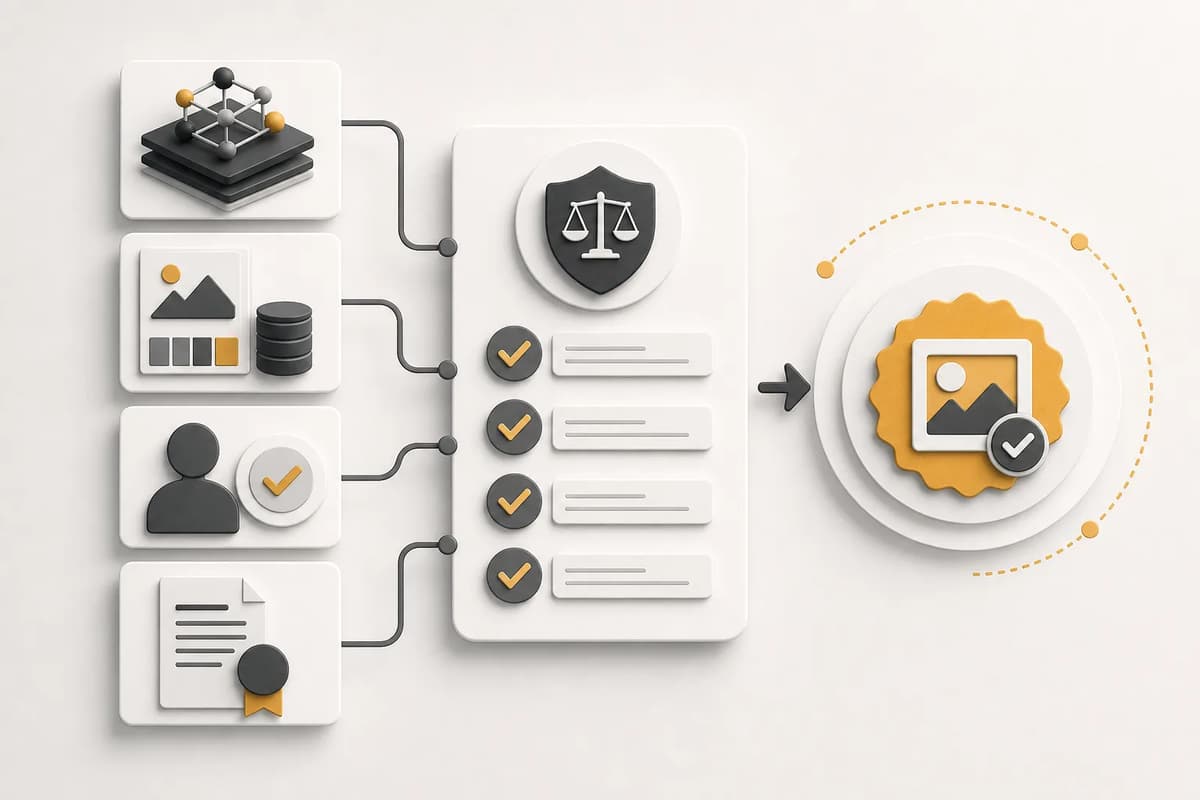
Start with a rights map. Platform terms govern your account and service use. Model licenses govern weights and sometimes outputs. LoRA or embedding licenses may add restrictions. Reference rights govern uploaded photos or art. Likeness and consent govern identifiable people. Intellectual-property rules govern characters, logos, and protected designs. Destination rules govern where adult material can appear.
| Layer | Evidence to keep | Common mistake |
|---|---|---|
| Platform | Terms version and account plan | Assuming paid access grants every output right |
| Base model | License text and exact version | Checking only the interface name |
| LoRA/add-on | Creator page, file revision, restrictions | Treating all assets in a stack as one license |
| Reference | Photographer/artist permission and source | Using a public image without reuse rights |
| Person/likeness | Specific consent for adult transformation | Treating general portrait consent as explicit consent |
| Brands/characters | Permission or a defensible legal basis | Believing AI generation removes third-party rights |
| Destination | Adult label, age gate, ad and storefront rules | Publishing wherever a file upload succeeds |
This is a practical review framework, not legal advice. Laws and contracts differ by jurisdiction. For material commercial risk, ask qualified counsel to review the exact assets and intended distribution.
Read the exact model version
Model names are not licenses. Find the exact checkpoint, LoRA, or hosted version used for the result. Save the page URL, revision, date, and license. If the model has changed since an earlier project, compare terms. A creator can publish different versions under different conditions, and an upstream base model may impose obligations that remain relevant.
Do not rely on a community summary when primary terms are available. If the license is missing or contradictory, contact the creator or choose another asset. The Civitai NSFW settings guide explains how discovery labels differ from usage permission, and the Civitai versus Hugging Face guide shows how to record files across hosts.
Obtain specific consent for real people
Permission to take or share a portrait is not necessarily permission to create adult or explicit derivatives. Consent should identify the person, source files, intended transformation, level of adult content, allowed audiences, commercial use, duration, and revocation process. Do not use images of minors or age-ambiguous people. Do not create non-consensual sexual impersonation, leaked-media derivatives, or coercive scenarios.
A provider’s real-person mode or safety review is an extra safeguard, not your consent record. Keep consent evidence private and access-controlled. Do not embed names, emails, or identity documents in prompts, file names, public metadata, or analytics. Review the real-person consent and privacy guide before any adult animation or makeover involving a recognizable person.
Check references and training-style assets
For every uploaded image, identify who made it and what reuse is permitted. A commission may grant display rights but not model training or derivative generation. A stock license may restrict sexual or defamatory contexts. A screenshot may include copyrighted material and private information. An original fictional character may still contain licensed wardrobe, logos, or franchise elements.
Use references you created, licensed, or received with explicit permission. Keep neutral identity references separate from adult results. Remove unnecessary metadata and avoid public-by-default share links. Flowith’s Adult Character Creator accepts an optional reference; the uploader still remains responsible for authorization.
Review output and publication context
Generated outputs can contain unintended text, logos, faces, or recognizable design elements. Inspect the image at full size. Confirm that subjects are clearly adult and that the scene reflects consent. Look for accidental resemblance to a real person when the brief was fictional. Remove watermarks or branding only when you are authorized; do not hide provenance to evade a rule.
Then review the destination. Adult storefronts, social networks, ad platforms, and client portals have different requirements. Some permit adult material but ban promotion. Some require labels or restricted accounts. Some prohibit explicit content entirely. Document where the asset will appear, who can access it, and how it will be labeled.
Create a release record
For each commercial asset, save:
- Final file and internal project identifier.
- Creation date and responsible creator.
- Model names, exact versions, and licenses.
- Authorized references and permission records.
- Consent record for any identifiable person.
- Human edits and disclosure notes.
- Destination policy check and adult label.
- Approval status and reviewer.
Keep the record separate from public Media History or captions. It should be accessible to the team that handles rights questions but not leak sensitive identity information. Update it when an asset is revised or republished in a new context.
Avoid unsupported commercial claims
Do not tell clients that an AI output is “copyright-free,” “fully owned,” or “commercially safe” without a basis. Instead, state what you checked: “Generated with model version X under license Y using creator-owned references; destination policy reviewed on date Z.” This language is narrower and auditable.
Likewise, do not promise that a service removes all risk. A focused workflow can reduce accidental variation and make inputs easier to review, but it cannot establish rights you do not have. Safety filters can reject certain requests, but they cannot determine every jurisdiction’s law or every private agreement.
Final commercial-use checklist
Before delivery, confirm that the adult subject and audience are lawful, the model stack is documented, every reference is authorized, any real-person use has specific adult consent, output details are reviewed, the destination permits the material, and records are retained. If one answer is “unknown,” treat it as unresolved. A disciplined rights map is less exciting than a new model, but it protects the creator, the depicted person, the client, and the distribution channel.