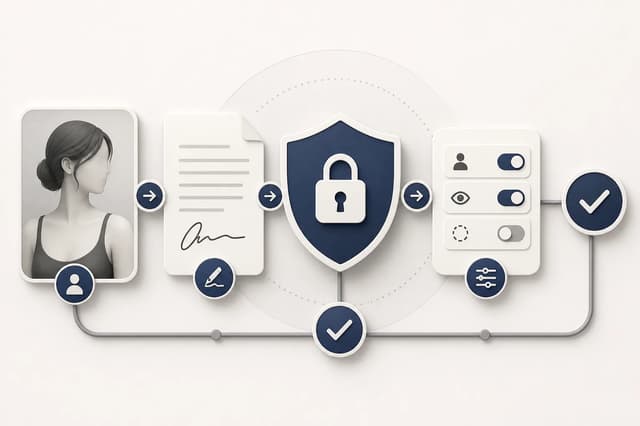
Before any adult AI generation, confirm that every subject is clearly an adult, every real person has specific permission, the scene is consensual, the source is authorized, and the destination permits the result. Stop on age ambiguity, coercion, private or leaked media, sexual impersonation without consent, or any attempt to evade provider rules. Product controls and model moderation reinforce these duties; they do not replace them.
Apply five checks before upload
Use a short gate before prompt writing:
| Check | Pass condition | Stop condition |
|---|---|---|
| Age | Every subject clearly adult | Minor or age ambiguity |
| Consent | Specific permission for intended adult use | No permission, coercion, or withdrawal |
| Source | Creator-owned or licensed reference | Leaked, private, stolen, or unknown source |
| Scene | Consensual adult context | Threat, exploitation, incapacity, or abuse |
| Destination | Adult content allowed and correctly labeled | Platform prohibition or hidden distribution |
If one check is unknown, do not generate. Replacing a direct word with a euphemism does not change the underlying request.
Make adult status unambiguous
Prompts should say adult, but text alone cannot repair a source image that looks underage or ambiguous. Use mature facial structure, body proportions, wardrobe, setting, and context appropriate to an adult. Avoid school settings, childlike styling, or terms that intentionally blur age.
Fictional characters are not exempt. If the depicted design appears minor or ambiguous, stop. Provider rejection may be correct even when the creator asserts an adult age in metadata.
Require affirmative consent
Consent must be voluntary, informed, specific, and applicable to the intended use. A person who agreed to a normal portrait did not necessarily agree to an adult makeover or explicit animation. A person who agreed to private review did not necessarily agree to public commercial distribution.
For real people, follow the real-person NSFW consent guide. Keep consent evidence outside prompts and public metadata. Never use a private or leaked image as a shortcut around permission.
Prohibit coercive and exploitative requests
Do not create scenes of non-consensual sexual activity, exploitation, trafficking, blackmail, intoxication that removes capacity, or sexual violence. Relationship labels do not establish consent. Describe adult agency and voluntary participation where relevant.
Do not create sexual impersonation of a real person without specific permission. Do not target a private individual for humiliation or reputational harm. Do not use adult AI as a threat or harassment tool.
Respect product capability locks
Higher intensity, real-person mode, longer video durations, and certain explicit actions can be paid features. A free trial should not bypass them. The frontend should lock them before quote or run creation, and the Worker should enforce entitlement again before credits or provider submission.
After a free trial is consumed for an app, all generation controls should lead to one consistent subscription prompt. That is a product rule, not a public content topic; landing-page copy should focus on what the tool creates and how to use it safely.
Accept provider refusal
Generation providers apply safety review to inputs and outputs. A refusal is not proof that your intent was malicious, but it is a boundary for that request. Do not split a prohibited request into smaller parts, hide it behind coded language, or repeatedly retry equivalent prompts.
If a request is lawful and consensual but ambiguous, clarify adult status, source authorization, and the visible scene. If it remains refused, choose a different permitted direction or fictional character. The mature versus explicit guide explains how to express actual visual outcomes without vague intensity labels.
Review outputs for unexpected harm
Models can introduce additional people, alter apparent age, change expressions, create text, or produce an unintended coercive reading. Review the result rather than assuming the prompt was followed. For video, inspect beginning, middle, and end. For comics, inspect every person in the frame.
Output checklist:
- Every subject remains clearly adult.
- The scene reads as consensual.
- Authorized identities remain within agreed scope.
- No unintended person, private detail, logo, or text appears.
- Anatomy and expressions do not create a different harmful context.
- The destination’s adult label and age gate are ready.
Use a focused workflow
Focused inputs reduce ambiguity. Flowith Adult AI separates Adult Character Creator, Adult Comic Generator, NSFW AI Image Editor, NSFW Image to Video, NSFW AI Video Editor, Adult Makeover, and Adult Video Continuation. Choose the workflow that matches the source and result instead of forcing every task into one page.
These workflows do not guarantee approval or rights. They make the intended input and output easier to understand and review.
Publish with audience controls
Before sharing, check the destination’s current adult and synthetic-media rules. Apply age restriction, content labels, and disclosure where required. Do not post adult material into a general-audience space because the upload technically succeeds. Keep source permissions and model records private but available.
The NSFW model licensing guide covers commercial rights, while the upload privacy guide covers file handling.
Final takeaway
Adult AI safety is a sequence of clear decisions: adult status, specific consent, authorized source, consensual scene, product eligibility, provider review, output inspection, and destination controls. If any link fails, stop. A narrower fictional brief is always preferable to forcing an unsafe or unauthorized request through the system.
Teams should make the stop decision easy. A reviewer must be able to reject an input without being asked to solve the prompt. Keep an escalation path for uncertain rights and a removal path for reported misuse. Training examples and preset covers should use fixed reviewed media, not public user uploads. These operational choices reduce pressure to improvise when a risky request arrives.
Review these rules after a provider, product control, or publishing destination changes. Preserve the strictest invariant—clearly adult, consensual, authorized subjects—even when interfaces and labels are updated.